






 Feed
Feed Scan with QR Code Reader
 mobi
mobi- Advertise / Donate
Welcome !
Newquay weather receives over 1000 vistors per day winter time, rising to over 3000 to 4000 or more in the summer, including visitors from all over the world.
Please help support this site

Your business

Via Paypal
- Accommodation
Hotels, B&B's and Caravan and Camping Sites

Porth Sands - Luxury beach accommodation wth beach facing balconies, a golden sandy beach making it the perfect place to idle away the hours- swimming, body boarding, sunbathing and paddling.
- Food
Restaurants, Cafe's, Takeaways

Pachanga - Pachanga Authentic Mexican Since 2016 we've been re-creating dishes that are part of our cultural heritage using techniques that are unique to Mexico. We use mostly Mexican, local & organic produce in our dishes & drinks
- Charity Events
Charity Events - Max 3 free ads
For a Free Charity Ad Here, please contact me- - Houses for Sale
Houses for Sale
Advertise your house for sale here and help support this site.
Small photo, text + link to agents for a One off ₤25. Please contact me.Advertise your house for sale here
- Local Services
Shops, Services etc

Towan Insurance BrokersCornwall's local commercial insurance specialist. We help Cornish businesses find the right cover, from tradespeople and property owners to specialist contractors. Based in Cornwall, independent, and genuinely invested in the businesses we work with. Visit us at Towan Insurance Brokers
Icelandic Volcanos
Aviation colour code map |
Webcams |
|---|---|
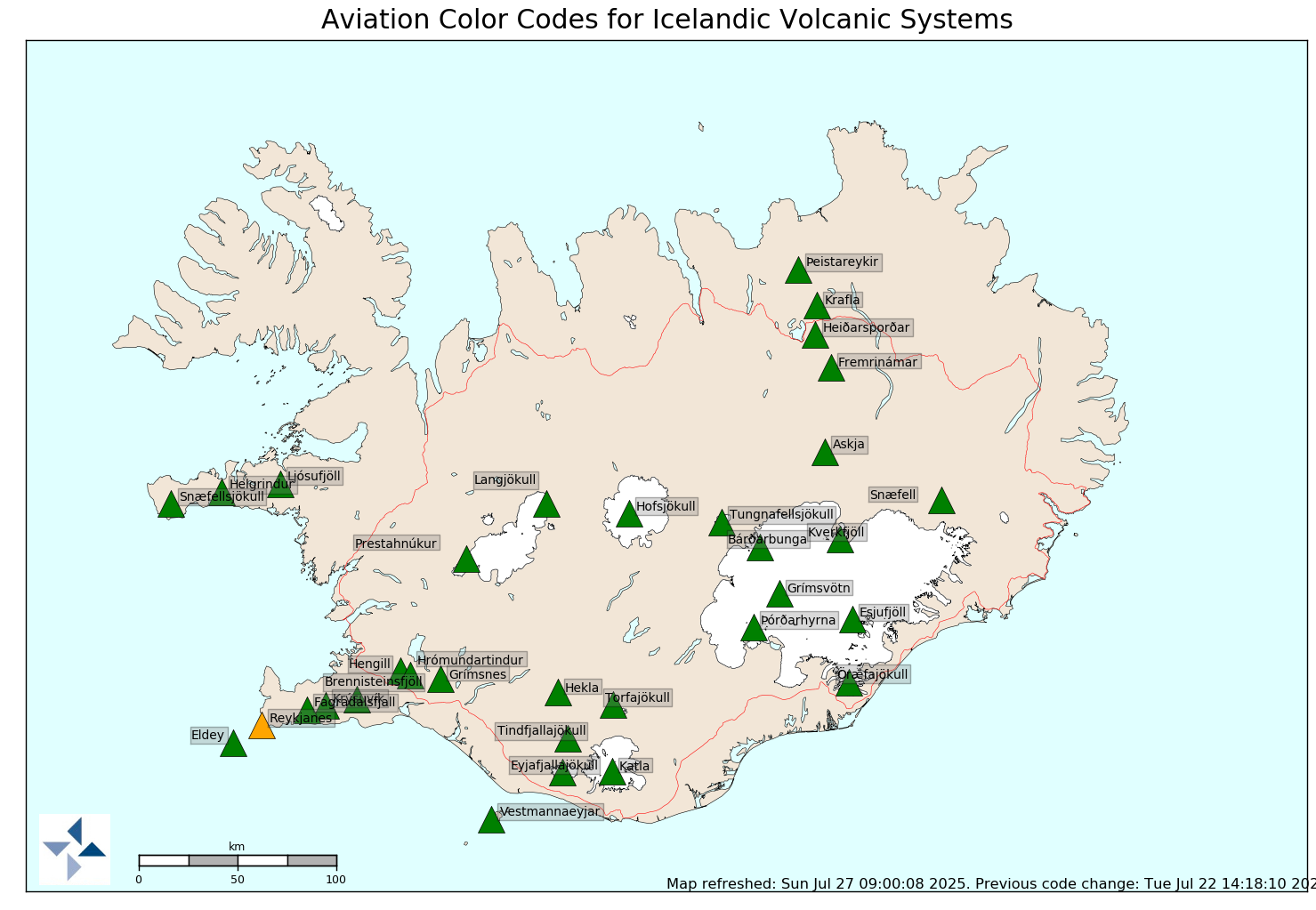
Click for enlarged aviation colour code map |
 Web cameras from Mķla |
| Icelandic Meteorological office - News |
|---|
Icelandic Meteorological office |
| September 1st, 2026 12:58:00 EDT -0400 Increased electrical conductivity and gas pollution at MĆŗlakvĆsl The glacial outburst flood in MĆŗlakvĆsl, which began on 18 August, now appears to be subsiding. Both conductivity and discharge have decreased since yesterday, and currently there is no gas pollution being detected in the area |
| August 18th, 2026 08:49:00 EDT -0400 Situation on the Reykjanes Peninsula Magma accumulation and ground uplift continue beneath Svartsengi. The average rate of magma accumulation over the past few weeks has remained steady. The most likely scenario remains continued slow magma accumulation, eventually leading to a new dike intrusion and possibly a volcanic eruption. |
| August 14th, 2026 09:40:00 EDT -0400 Measurements show that uplift at Askja has ceased Measurements by the lake in Askja. Fieldwork in the area was completed this week, and the results indicate that the uplift episode that began in 2021 has ended. |
| July 22nd, 2026 10:18:00 EDT -0400 Increased hazard due to changing conditions at the margin of SĆ³lheimajƶkull glacier Recent changes at the terminus of SĆ³lheimajƶkull call for increased caution. Unstable glacier ice and rockfall from the surrounding slopes may pose a risk to people visiting the area. |
| June 9th, 2026 11:45:00 EDT -0400 Ground uplift and magma accumulation continue beneath Svartsengi Uplift and magma accumulation continue at Svartsengi, and the trend remains stable. The latest model calculations indicate that around 27.5 million cubic metres of magma have accumulated beneath Svartsengi since around mid-July last year. |
| June 3rd, 2026 07:22:00 EDT -0400 The Icelandic Met Office
receives international grant to strengthen aviation safety in relation to
volcanic hazards In October 2025, the Icelandic Meteorological Office (IMO) received a grant of ISK 147 million from the International Civil Aviation Organization (ICAO) for four new development projects in the fields of volcanic hazards and aviation safety. The projects involve, among other things, the development of new measurement methods, automatic analysis of eruption plumes, coordination of responses among European volcano observatories, and research into the effects of sulphur dioxide (SOā‚‚) on aviation. |
| May 12th, 2026 09:20:00 EDT -0400 IMO expert to lead international collaboration on geohazards Michelle Parks, a specialist in deformation measurements and volcano monitoring at the Icelandic Meteorological Office (IMO), has been elected Chair of GEO-GSNL, the Geohazard Supersites and Natural Laboratories initiative. She formally assumed the role on 7 May 2026. |
| February 5th, 2026 06:37:00 EST -0500 Nordic report on the impacts of a AMOC tipping
urges stronger mitigation, monitoring and preparedness The report A Nordic Perspective on AMOC Tipping reviews the current state of science on the impacts of potential Atlantic Meridional Overturning Circulation (AMOC) collapse and provides recommendations for policy actions. |
| February 4th, 2026 10:45:00 EST -0500 The weather in Iceland in 2025 The year 2025 was the warmest year in Iceland since measurements began. The national average temperature was 5.2 Ā°C, which is 1.1 Ā°C above the average for the years 1991ā€“2020 and the highest ever recorded. Temperatures were well above average for almost every month of the year. The spring weather was exceptionally favourable; it was the warmest spring ever recorded nationwide, and May was by far the warmest May on record. In mid-May, a 10-day heatwave occurred across the entire country. It was the most significant heatwave known in Iceland for the month of May. Overall, the weather in 2025 was unusually calm, with few stormy days and generally favourable conditions. It was relatively wet at the beginning of the year but dry toward the end. Snow cover was light across the entire country. |
| February 3rd, 2026 11:55:00 EST -0500 SeisComP becomes the new primary earthquake monitoring
system of the Icelandic Meteorological Office The implementation of SeisComP represents a major step forward in the development of the IMO's earthquake monitoring capabilities. Preparations have been underway for several years, and the system transition involves both technical and procedural changes aimed at improving analytical capability, data dissemination, and providing a more modern working environment for specialists. |
| August 5th, 2025 05:34:00 EDT -0400 The ninth eruption on the SundhnĆŗkur crater row has ended Updated 5 August The volcanic eruption that began on 16 July on the SundhnĆŗkur crater row is now officially over, and a new hazard map has been issued. Despite the end of the eruption, life-threatening conditions remain in the area due to unstable lava and the potential for gas pollution. Uplift has resumed, and magma continues to accumulate beneath Svartsengi. |
| July 16th, 2025 07:57:00 EDT -0400 Heavy thunder and lightning in Northwest Iceland and the Westfjords By 11:00, more than 450 lightning strikes had been recorded since the activity began. |
Could Bįršarbunga erupt in the near future. On August 16 and August 17, Icelandic scientists detected a pair of earthquake swarms in and around the volcano.
The area north of Vatnajokull glacier has been closed, and a widespread evacuation order is in effect, in the wake of ongoing earthquake activity around the subglacial volcano Bardarbunga, which is located in the northwestern part of the glacier.
There is currently no immediate danger, but if the volcano erupts, a major flood is expected to the north, fed by melting ice from the glacier.
London Volcanic Ash Advisory Centre VAAC
The London VAAC is an International Civil Aviation Organization (ICAO) designated centre, responsible for issuing advisories for volcanic eruptions originating in Iceland and the north-eastern corner of the North Atlantic.
Updates
3/10/2014 15:00 Filming an active volcano, using a DJI Phantom Quadcopter 2 drone. See the full video: here22/9/2014 9:30 This will be the last update unless activity increases
Seismic activity has been persistent, but at comparably low levels during the last hours. Since midnight around 10 earthquakes have been automatically detected on the caldera rim of Bįršarbunga. Another around 10 earthquakes were detected in the northern part of the dyke intrusion, all smaller than magnitude 2. Yesterday (21 September), between 19:00 and 24:00, 25 earthquakes were measured: 8 at Bįršarbunga, 13 at the northern end of the dyke and 2 at Heršubreiš. Earthquakes over M3.0 at Baršarbunga between19:00 21 September and 06:00 22 September:
at 19:51 M3,5
at 20:07 M3,7
at 23:08 M3,5
at 00:19 M3.6
at 03:13 M3.7
at 05:28 M3.5
The volcanic activity at the eruption site appears to be stable, based on webcam observations this morning.
21/9/2014 9:30
Last evening (19:00-24:00) about 30 earthquakes were detected, 10 at Bįršarbunga, 10 at the northern end of the intrusion and 5 at Heršubreiš and Heršubreišartögl (Töglin). The largest one was at Bįršarbunga at 22:46 3.9 and five more in the same area were over 3 in size.
From midnight til morning (24:00-07:00), automatically detected events are also around 30, most of them around northwestern Vatnajökull. The four largest events were all in northern part of Bįršarbunga caldera:
at 00:57 magnitude 4.8
at 02:21 magnitude 3.8
at 03:05 magnitude 3.7
at 03:30 magnitude 3.4
No visible changes in eruption at Holuhraun from webcams.
20/9/2014 9:40
Around 30 earthquakes have been automatically detected around northwestern Vatnajökull since midnight. Of these, around 10 were located on the Bįršarbunga caldera rim and another 15 in the northern end of the dyke intrusion. The strongest event was a magnitude 5.1 on the north-eastern caldera rim at 01:10.
19/9/2014 9:40
Since 19h yesterday evening only about 10 earthquakes were recorded at the Bardarbunga caldera and only 3 from midnight until 06:00 this morning. One, with magnitude 4.5 occurred at the northern rim of the caldera at 21:43. Two other earthquakes with magnitude over 3 occurred there at 23:44 and 01:57. At 06:44 this morning an earthquake of magnitude 4.7 occurred at the northeastern rim of the Bardarbunga caldera.
18/9/2014 10:45
The largest earthquakes recorded in Bardarbunga since 19:00 yesterday. A magnitude 3.2 earthquake occurred at 22:28, M4.1 earthquake at 22:52 , M3.5 at 23:35, M4.5, at 03:17 and M3.4 at 06:05. From midnight 13 earthquakes have been detected in Bįršarbunga, about 27 in the northern part of the dyke and around 20 by Heršubreiš and Heršubreišartögl, all below magnitude 2.
17/9/2014 10:00
The largest earthquakes recorded in Bįršarbunga since 19h yesterday occurred in the evening. A magnitude 4.8 earthquake occurred at 20:20 and a 5.4 earthquake at 21:34. From midnight 40 earthquakes have been recorded: 5 in Bįršarbunga, about 15 in the northern part of the dyke and around 20 by Heršubreiš and Heršubreišartögl, all below magnitude 2.
16/9/2014 22:50
Nearly 100 earthquakes have occurred since midnight. Just over 20 at Bįršarbunga and over 30 in the intrusion under Dyngjujökull and near the eruptive site. Earthquakes at the northern rim of Bįršarbunga caldera today were at 09:13 M3,4 and at 10:36 M4,8 and at 16:13 M3,7. At the southwestern rim there was an earthquake at 14:47 M5,2
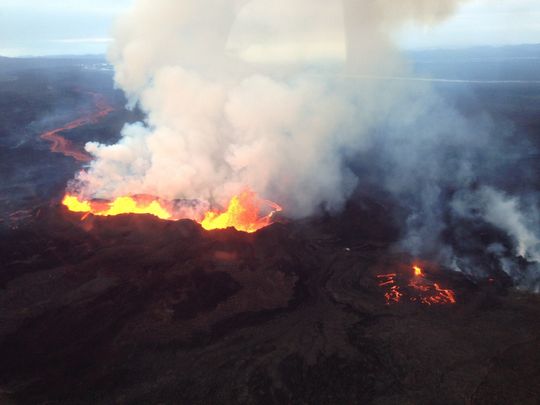
The eruption site in Holuhraun at 18:40 today, 16 September 2014. Photo: Freysteinn Sigmundsson.
15/9/2014 09:00
No major changes are observed in the seismicity. 23 events were measured near Bįršarbunga and the dyke, of these nine occurred in Bįršarbunga. This rate is similar as two nights ago. The largest events were of magnitude M3.6 at 00:11 and M3.7 at 00:14 at the southern rim. Another one occurred at 02:27, M3.4 (size not confirmed yet) at the western rim. Swarms at Heršubreiš, Heršubreišartögl and Dreki continue (around 15 events in these areas in total). Eruption continues at Holuhraun.
14/9/2014 11:00
No major events have occurred since midnight, the largest events were at 01:47 M 3.5 and at 06:54 M 4.0 at the south- and southeastern rim of Bįršarbunga. According to webcam the eruption in Holuhraun still continues on one central crater (Baugur). The vertical displacement of the GPS-instrument on the ice-shelf at Bįršarbunga is around -20 cm from midnight.
13/9/2014 10:00
Since midnight, around 20 earthquakes have been recorded in the north-west region of Vatnajökull. Earthquake locations are similar to recent days: in Bįršarbunga, in the dyke intrusion near to the edge of Dyngjujökull, and occasionally at Heršubreišartögl.
12/9/2014 10:00
Thirty earthquakes have been recorded, mostly located in the dyke under Dyngjujökull and at the eruption site, and at the northern rim of Bįršarbunga. The largest earthquakes are around magnitude 2. A few earthquakes have occurred by Askja, Heršubreišartögl and Tungnafellsjökull.
11/9/2014 09:05
Earthquake activity is continuing in Bįršarbunga and in the northern part of the dike intrusion. The largest events occurred just after midnight (00:07:38, M5.3) at the southern caldera rim of Bįršarbunga and around five o'clock (05:00:38 of M4.3 and 05:04:49 of M3,0) at the northern rim of Bįršarbunga. Eruption is still ongoing.
10/9/2014 10:00
Earthquake activity is continuing in Bįršarbunga and in the northern part of the dike intrusion. Fewer events were detected at Heršubreišartögl. Eruption continues north of Dyngjujökull.
09/9/2014 22:30
Since this morning, 230 earthquakes have been recorded. The main activity has been in the northern part of the dyke, north of Heršubreiš, by Heršubreišartögl and at the rim of Bįršarbunga. No earthquakes larger than magnitude 3 have been recorded since 01:07.
08/9/2014 13:30
The earthquake activity today continues at the northern part of the dyke intrusion. The largest earthquake in the dyke since the end of August occurred at 16:27 today with magnitude 4.5. An earthquake swarm is taking place north of Heršubreiš. About 80 earthquakes have been recorded so far today
The earthquake activity since midnight continues at the northern part of the dyke intrusions and at Bįršarbunga. Between 30 and 40 events have been located in the area since midnight.
07/9/2014 18:30
The lava tongue now extends 11 km to the north and has reached the western main branch of Jökulsį į Fjöllum river.
Earthquake activity continues in Bįršarbunga, in the northern part of the dike intrusion and in Heršubreišartögl. Total of 70 earthquakes have been detected since midnight, the largest M5,7 at 07:08 in the Bįršarbunga caldera. The lava has reached Jökulsį į Fjöllum. Steaming occurs.
06/9/2014 15:25
The surveillance flight yesterday the ice-surface at Bįršarbunga was measured with the radar system of Isavia's aircraft. The measurements show large changes on the ice-surface. Up to 15 m subsidence has occurred in the centre of the caldera, which corresponds to a volume change of 0.25 km³. The shape of the subsidence area is in accordance with the elevation of the caldera floor having lowered by that amount. The most probable explanation is that this subsidence is related to the recent high seismic activity and subsurface magma flow to the northeast.
Earthquakes have been recorded in similar locations as in recent days: in Bįršarbunga, in the dyke intrusion beneath and north of Dyngjujökull and occasionally at Heršubreišartögl. At 05:40, an earthquake of magnitude 5 occurred on the rim of the Bįršarbunga caldera. Since midnight, the total number of automatically located earthquakes is around 50
05/9/2014 09:20
Two earthquakes of magnitude 4.3 and 5.2 occurred on the rim of the Bįršarbunga caldera. The first earthquake was recorded at 23:33 yesterday and the larger event at 01:19.
Toxic gases from the Holuhraun eruption have been measured up to six kilometers (four miles) high. Mostly it contains sulfur dioxide and scientists found some poisoning effect in the first day of the eruption. Up to now forty million cubic meters (1.200 million cubic feet) of lava have come out of the craters in Holuhraun.
04/9/2014 07:00
Since August 16th, 13 earthquakes have measured over 5 in magnitude.
03/9/2014 12:00
Seismic activity continued at similar rate as yesterday until 03:09 when M5.5 earthquake was measured in northern part of Bardarbunga. After that there was increase in activity both in the area under the northern part of Dyngjujokull, south of the current eruption site as well as in Herdubreidartogl. The Aviation Colour Code for Bįršarbunga remains at ‘orange' and the code for Askja at ‘yellow'.
02/9/2014 12:00
A noticeable decrease in seismicity has occurred during the last 24 hours. The level of activity is approximately half of that during recent days.
Volcanic activity in Holuhraun continues at steady rate. According to webcam observation there is no visible change in activity since yesterday with effusive lava eruption and fountains.
01/9/2014 19:00
Since midnight over 700 earthquakes have been detected automatically which is somewhat fewer than in the past few days. The main activity is in the dyke. Two earthquakes occurred by the northern rim of the Bardarbunga caldera, at 08:58 AM M5.0 and 11:41 AM M5.3. Over 140 earthquakes were detected by Heršubreišartögl, NE of Askja volcano. A few earthquakes were detected near Askja.
31/8/2014
31/8/2014 The new eruption in Holuhraun at 07:15. Video: Benedikt G. Ófeigsson.
The Aviation Colour Code for Bįršarbunga was raised at ‘red' this morning and it has been moved back to 'orange' since 15:00 UTC. The color code for Askja is at ‘yellow'.30/8/2014 Around 450 earthquakes have been detected since midnight 29/30 August until 07:00, the vast majority in the northern part of the dike intrusion Several events have been detected on the caldera rim of Bįršarbunga, strongest were M4.5 at 02:35 and M4.2 at 06:18, both on the northern rim. A magnitude M5.4 earthquake occurred at 07:03 at the southern rim of Bįršarbunga caldera. Several events of similar size have occurred around the caldera rim in recent days.
Summarizing, no significant changes in seismic activity have been observed.
Update
Icelandic authorities briefly raised the aviation warning code to red Friday after a small fissure eruption near Bardarbunga volcano, but no volcanic ash was detected by the radar system.
29/8/2014
Earthquake activity is high
At 11:14:59 AM (29 August) an earthquake of M4.8 occurred by the northern rim og the Bardarbunga caldera.
And yesterday
| Size | Time | Location |
|---|---|---|
| 5.0 | 28 Aug 08:13:40 | 7.3 km ENE of Bįršarbunga |
| 4.8 | 29 Aug 11:14:59 | 4.9 km NE of Bįršarbunga |
| 4.1 | 28 Aug 01:30:52 | 6.8 km E of Bįršarbunga |
24/8/2014
Iceland lowered its aviation alert level to orange from red Sunday, saying there was no sign of an imminent eruption at the Bardarbunga volcano. And scientists at the Icelandic Meteorological Office said their announcement Saturday that the volcano had experienced a subglacial eruption was wrong.
An orange alert indicates “heightened or escalating unrest with increased potential of eruption.”
23/8/2014
Icelandic Met Office:
A small sub-glacial volcanic eruption has started near Bardarbunga volcano, under the icecap of Dyngjujökull glacier in the northern part of Vatnajökull glacier, according to the Icelandic Met Office. All air traffic is now prohibited in a large radius around the volcano.
21/8/2014
The intense earthquake swarm continues with no significant changes. There are no signs of magma migrating towards or reaching the surface are present, although the risk of a subglacial eruption in the near future remains high.